
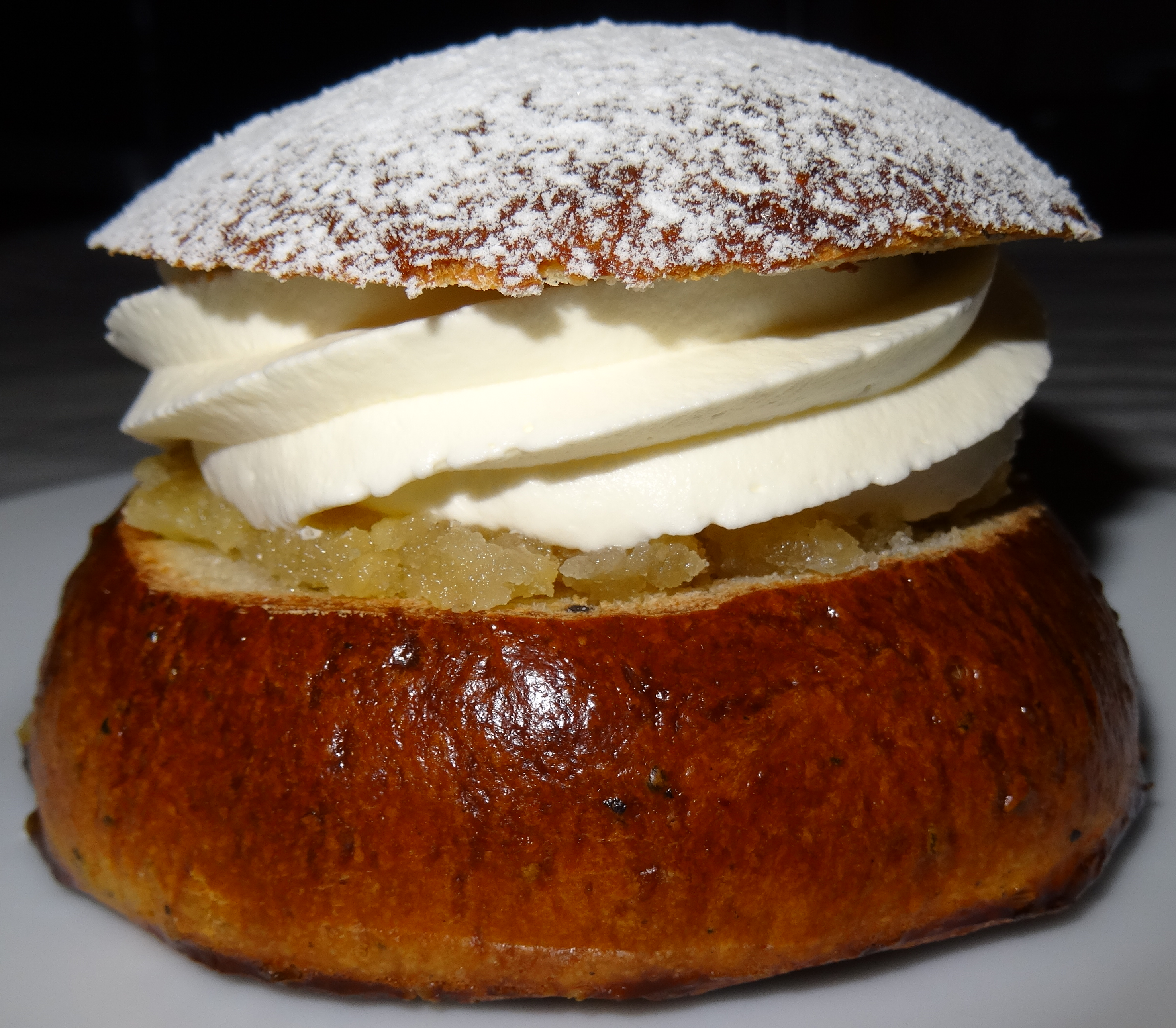
Swedish semlas (a classic "Shrove Tuesday" pastry)
Levain: 12 hours prior to mixing the final dough
- 9 gram sweat wheat sourdough starter
- 47 g strong wheat flour
- 47 g water
- 10 g cane sugar
- 599 g strong wheat flour
- 299 g milk (1.5% - 3% fat)
- 90 g caster sugar
- 100 g unsalted butter
- 40 g egg yolks and 68 g lightly beaten egg
- 13 g salt (Note: Add the salt after the flour and once the dough has come together. Otherwise, the salt may kill the yeast/sourdough.)
- 20 g cardamum seeds
- 3 g powdered vanilla sugar
- + levain
- almond paste or crème pâtissière (tradition suggests almond paste)
- whipped cream
- 100 g icing sugar
- 200 g almond flour (process scalded almonds in the blender until it turns into almond flour)
- 1½ tbsp of water - adjust to proper viscosity
- 0.4 US tea spoon of non-toxic bitter almond extract
- 1 egg white
Just mix the ingredients into a tough paste. If you use your potato masher: Watch out so you don't brake it. This is much tougher than mashing potatoes!
Whipped cream
OBS! Adjust to the number of semlas you're making. For 10 semlas 2.11 cups of heavy cream should suffice.
Don't use whipped topping / canned whipped cream. This tastes much better.
For 2 semlas use:
- 0.42 cu heavy cream
- 2 tbsp of sugar
Beat the whipping cream until stiff peaks form. Don't over-whip it! Whipped cream can turn from fluffy clouds of sweet cream to a curdled mess very fast!
If you use caster sugar beat it slowly and stir some so the caster sugar has time to dissolve in the water contained in the cream.
Notice: For just 2 semlas you may want to scale it up since it's hard to pipe such a small volume of whipped cream.
Brush the buns with egg wash before they go into the oven
- 1 egg
- a splash of milk
Beat the egg somewhat and combine with milk.
Schedule
Monday 09:00 pm - 10h - Tuesday 07:00 am - 25h - Wednesday 08:00 am - 72h - Saturday 08:00 am - 10h - Saturday 06:00 pm - Bake at 482 °F / 250 °C
Instructions
- Calculation: 10 Semlas, weight of dough: 1312 g. Subtract 12 g of dough in order to compensate for what's left stuck in the bowl. Which implies 10 pieces of dough 130 g each.
- Melt the butter and mix with cold milk. The liquid should be finger warm 98 °F / 36 °C.
- Transfer the sugar, the luke warm liquid and the levain to the bowl of a large stand mixer or food processor.
- Grind the cardamom seeds in a mortar and pestle (I have to do it in 5 portions (4 g at a time) with my medium size mortar and pestle.)
- Add vanilla sugar, ground cardamom seeds, the egg and egg yolks and combine in your mixer.
- Add the strong wheat flour and start to combine into a dough in your mixer.
- Once the dough has come together somewhat, sprinkle the salt over it. Run the mixer for a while so the salt is incorporated. It does not need to pull away from the sides of the mixer bowl. The dough should feel slightly elastic, but not sticky to the touch.
- Leave to rise 24 hours in room temperature (72 °F / 22 °C) and 72 hours in your fridge.
- Take pieces of dough 130 g each and roll into balls (Don't roll them too compact. They'll have a hard time rising.)
- Put 5 balls on a parchment covered baking sheet. (Separate them well. They will expand.)
- Leave the two sheets with semla buns to rise under baking towels for 10 hours. (I put mine in the oven when it's cold.)
- Brush the buns with egg wash just before the go into the oven.
- Bake each sheet in the oven at 482 °F / 250 °C for app. 16 minutes. They're ready when they look nice and brown.
- When the buns have cooled down to room temperature: Cut off a lid of the top of the bun using a sharp chef's knife.
- Spread a 2/16 of an inch layer of almond paste on the entire cut surface, but only on the bottom half of the bun.
- On top of that: Pipe a whole layer of whipped cream using a star shaped tip.
- Put the lid cut off on a saucer and dust it with icing sugar.
- Carefully place it back on top of the whipped cream.
- Done! Munch at least one!
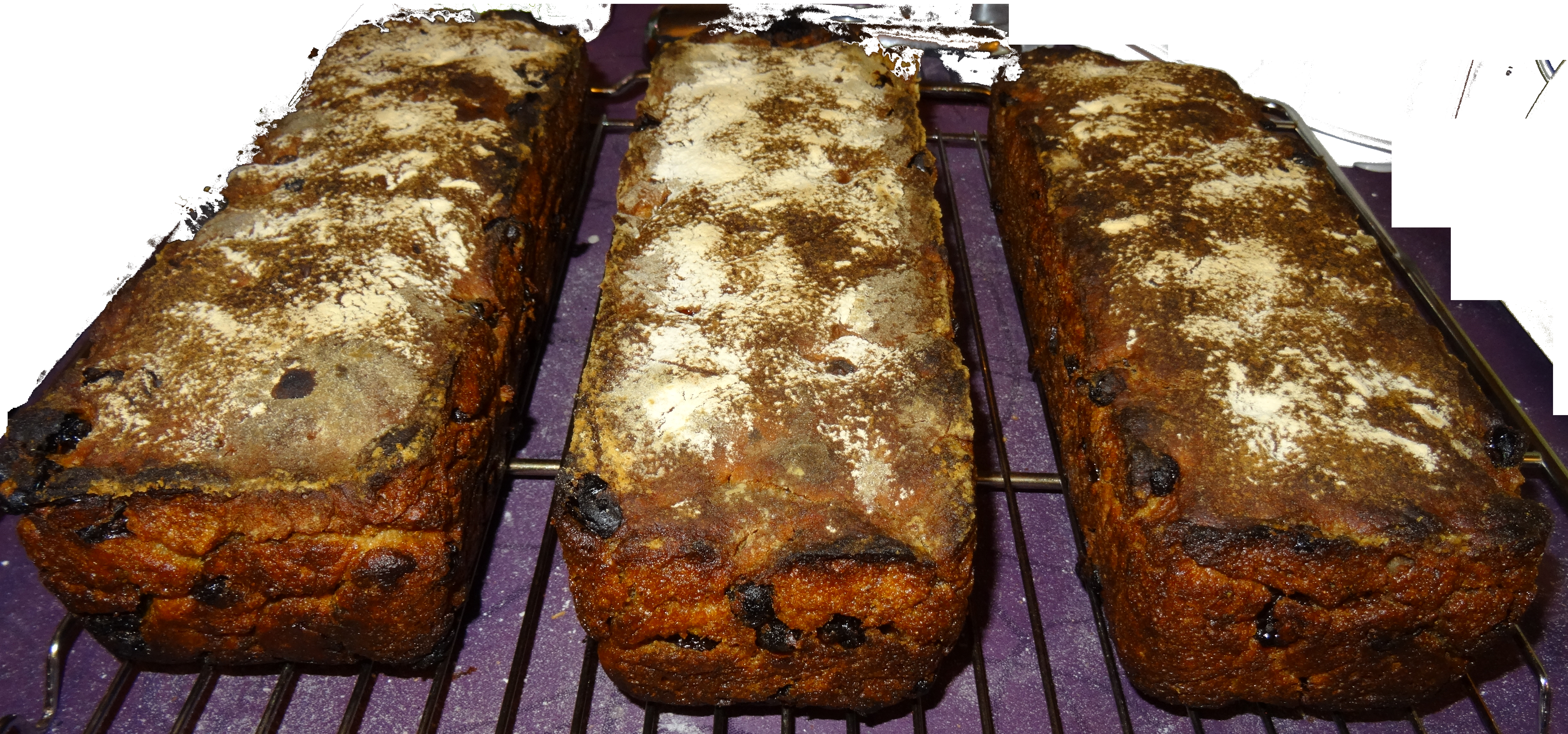
Swedish Rye Bread (Wort loaf with fresh yeast)
Scalding: 12 hours prior to mixing the final dough
- 183 g swedish Julmust ("must" is a black, sweet, carbonated soft drink. Don't use "Diet"! If you can't find it use 64 g of molasses and 118.7 g of water instead.)
- 125 g porter (a dark beer)
-
Reduce (boil away) 58 g of the Julmust-and-porter-mixture
(Warning: A lot of foam will be produced. Stir it down with a spoon. When you're done getting the right weight of your fluid and it's still hot one gram of fluid will evapourate every 7 seconds. So be fast when adding spices and rye flour. Prepare the mixture before you start boiling your fluid.) - 7.5 g dried, fine ground bitter orange peel (or 15 g boiled fine chopped bitter orange peel)
- ½ tsp ground ginger
- ½ tsp cardamom seeds coarsely ground with a mortar and pestle
- 1/4 tsp ground cloves
- 100 g fine ground rye flour
- 68 g swedish Julmust ("must" is a black, sweet, carbonated soft drink. Don't use "Diet"! If you can't find it use 24 g of molasses and 44 g of water instead.)
- 125 g porter (a dark beer)
- 3.5 g fresh yeast
- 10 g salt (Note: Add the salt after the flour and once the dough has come together. Otherwise, the salt may kill the yeast/sourdough.)
- 100 g scandinavian dark syrup
- 400 g sifted rye flour (60% fine ground wheat flour and 40% fine ground rye flour)
- 150 g raisins of good quality
- + scalding
Heat up the fluid ingredients of the scalding until boiling, pour over and mix with the spices and the rye flour. Leave in the pot with a lid on overnight for 12 hours. Mix all ingredients of the final dough in a bowl using a stand mixer equipped with a dough hook, or you can do it by hand using a wooden spoon. (Tip: Hold the spoon upside down mixing it with the handle to reduce resistance from the tough dough. Tip No.2: Hold it with a thick leather glove or you will get blisters.). Let it rise for 8 hours in the mixing bowl (covered). Butter a non-stick loaf-pan generously and put the dough in it. Distribute the dough very well using a metal spoon. Chop downwards to remove any air-pockets in the dough. Wet the back of the spoon and smoothen out the top of the loaf. Put it in a rising bag or produce bag and seal it. Put the loaf pan in a warm spot (77 °F / 25 °C) in the kitchen and leave it to rise for 2 hours. If should have risen about 50 %. Now bake it in the oven. Heat the oven to (392 °F / 200 °C or 437 °F / 225 °C for 3 loaves) with a baking sheet in the middle of the oven. Bake it for 35 minutes in the loaf pan. Turn the loaf pan over flipping the loaf upside down on to the baking sheet. Remove the loaf pan but keep the loaf upside down in the oven in order to caramelize the bottom crust. Stick a baking thermometer into the middle of the loaf. When the temperature reaches (208 °F / 98 °C) the loaf is done. Remove it from the oven. Let it cool on a cooling rack. Tip: When the bread is lukewarm it's ready to be sliced. Put the bread slices in the freezer. They'll stay fresh there for at least 6 months. Personally I don't want to eat bread that came out of the oven more than six hours ago. The time in the freezer doesn't count. When you want a slice: Heat it in a microwave oven for 25 secs at 900 W (or until it's a little bit warm). ENJOY!
Bitter orange peel preparation
Boil the bitter orange peels for 30 minutes. Cut off the white fluff inside the peels. Chop very fine. OBS! boiled bitter orange peels weigh substantially more than powder. Take twice the weight.
Swedish Rye Bread (Wort loaf with sourdough)
Scalding: 12 hours prior to mixing the final dough
- 183 g swedish Julmust ("must" is a black, sweet, carbonated soft drink. If you can't find it use 64 g of molasses and 118.7 g of water instead.)
- 125 g porter (a dark beer)
-
Reduce (boil away) 58 g of the Julmust-and-porter-mixture
(Warning: A lot of foam will be produced. Stir it down with a spoon. When you're done getting the right weight of your fluid and it's still hot one gram of fluid will evapourate every 7 seconds. So be fast when adding spices and rye flour. Prepare the mixture before you start boiling your fluid.) - 7.5 g dried, fine ground bitter orange peel
- ½ tsp ground ginger
- ½ tsp cardamom seeds coarsely ground with a mortar and pestle
- 1/4 tsp ground cloves
- 100 g fine ground rye flour
- 40 g sourdough starter (wheat or rye)
- 80 g sifted rye flour (60% fine ground wheat flour and 40% fine ground rye flour)
- 68 g swedish Julmust ("must" is a black, sweet, carbonated soft drink. If you can't find it use it use 23.7 g of molasses and 44 g of water instead.)
- 66 g porter (a dark beer)
- 33 g porter (a dark beer)
- 10 g salt (Note: Add the salt after the flour and once the dough has come together. Otherwise, the salt may kill the yeast/sourdough.)
- 100 g scandinavian dark syrup
- 320 g sifted rye flour (60% fine ground wheat flour and 40% fine ground rye flour)
- 150 g raisins
- + scalding
- + levain
Heat up the fluid ingredients of the scalding until boiling, pour over and mix with the spices and the rye flour. Leave in the pot with a lid on overnight for 12 hours. Make the levain 12 hours before mixing the final the dough. Combine all ingredients in a bowl. Cover it with a lid or cling film and leave overnight. Mix all ingredients of the final dough in a bowl using a stand mixer equipped with a dough hook, or you can do it by hand using a wooden spoon. (Tip: Hold the spoon upside down mixing it with the handle to reduce resistance from the tough dough. Tip No.2: Hold it with a thick leather glove or you will get blisters.). Butter a non-stick loaf-pan and put the dough in it. Distribute the dough very well using a metal spoon. Chop downwards to remove any air-pockets in the dough. Wet the spoon and smoothen out the top of the loaf. Put it in a rising bag or produce bag and seal it. Put the loaf pan in a warm spot (77 °F / 25 °C) in the kitchen and leave it to rise for 12 hours. If it doesn't rise enough (about 50 %) leave it in a warm spot (77 °F / 25 °C) in the kitchen for another 24 h. Now bake it in the oven. If it's too late in the day. Leave it in the refrigerator until the morning. Heat the oven to (392 °F / 200 °C) with a baking sheet in the middle of the oven. Bake it for 35 minutes in the loaf pan. Turn the loaf pan over flipping the loaf upside down on to the baking sheet. Remove the loaf pan but keep the loaf upside down in the oven in order to caramelize the bottom crust. Stick a baking thermometer into the middle of the loaf. When the temperature reaches (208 °F / 98 °C) the loaf is done. Remove it from the oven. Wrap it in a baking towel and let it cool on a cooling rack. Tip: When the bread is lukewarm it's ready to be sliced. Put the bread slices in the freezer. They'll stay fresh there for at least 6 months. Personally I don't want to eat bread that came out of the oven more than six hours ago. The time in the freezer doesn't count. When you want a slice: Heat it in a microwave oven for 25 secs at 900 W (or until it's a little bit warm). ENJOY!
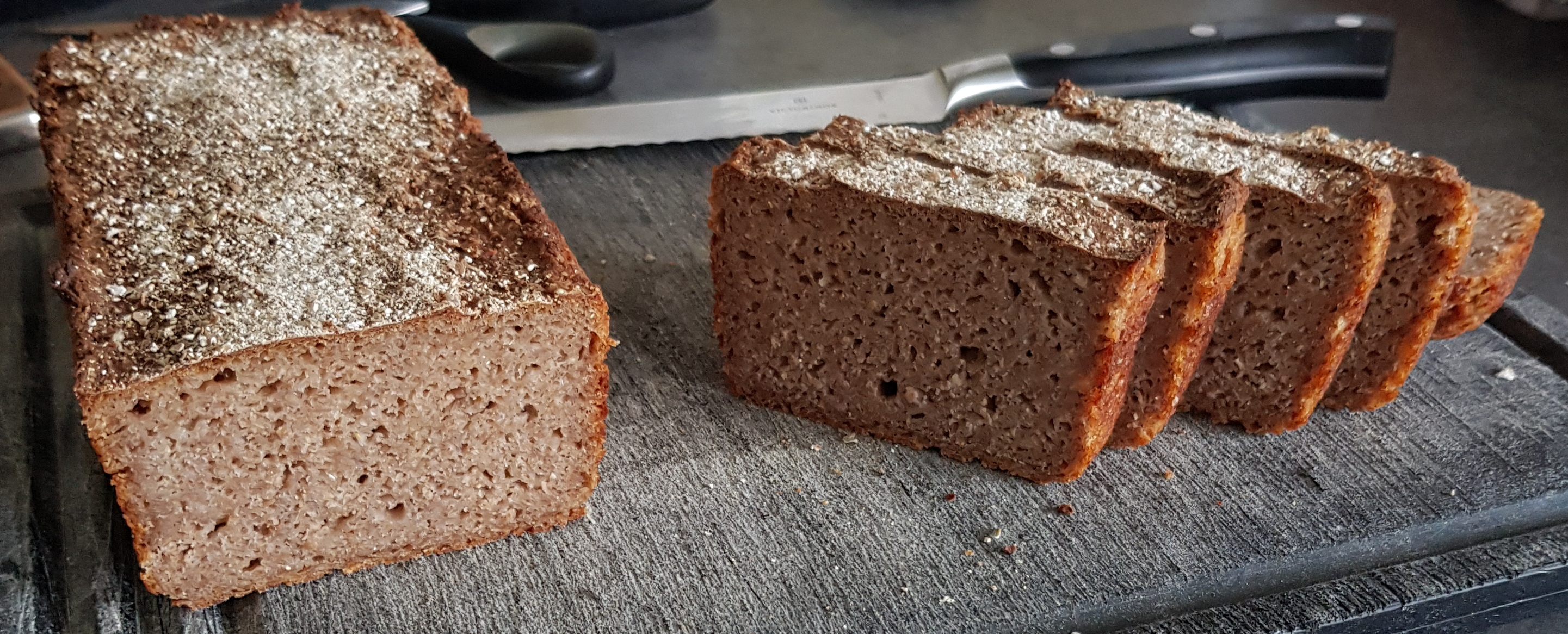
Swedish Rye Bread (Kavring with fresh yeast)
Scalding: 12 hours prior to mixing the final dough
- 2 g fennel seed
- 2.7 g caraway seed
- 100 g fine ground rye flour
- 250 g boiling hot water
- 125 g filtered water
- 5 g fresh yeast for sweet doughs
- 150 g scandinavian dark syrup
- 400 g sifted rye flour (60% fine ground wheat flour and 40% fine ground rye flour)
- 10 g salt (Note: Add the salt after the flour and once the dough has come together. Otherwise, the salt may kill the yeast/sourdough.)
- + scalding
Crush the spices in a mortar and pestle. Mix them with the flour an water of the scalding. Leave them with a lid on to soak over night. Mix all ingredients of the final dough in a bowl using a stand mixer equipped with a dough hook, or you can do it by hand using a wooden spoon. (Tip: Hold the spoon upside down mixing it with the handle to reduce resistance from the tough dough. Tip No.2: Hold it with a thick leather glove or you will get blisters.). Leave the final dough to rise for 8 hours in a warm (77 °F / 25 °C) spot in the kitchen. Butter a non-stick loaf-pan and put the dough in it. Distribute the dough very well using a metal spoon. Chop downwards to remove any air-pockets in the dough. Wet the back of the spoon and smoothen out the top of the loaf. Put it in a rising bag or produce bag and seal it. Put the loaf pan in a warm spot (77 °F / 25 °C) in the kitchen and leave it to rise for 2 hours. The loaf should now have risen about 50 %. Now bake it in the oven. Heat the oven to (392 °F / 200 °C) with a baking sheet in the middle of the oven. Bake it for 35 minutes in the loaf pan. Turn the loaf pan over flipping the loaf upside down on to the baking sheet. Remove the loaf pan but keep the loaf upside down in the oven in order to caramelize the bottom crust. Stick a baking thermometer into the middle of the loaf. When the temperature reaches (208 °F / 98 °C) the loaf is done. Remove it from the oven. Let it cool on a cooling rack. Don't wrap it and you'll get a crispier crust. Tip: When the bread is lukewarm it's ready to be sliced. Put the bread slices in the freezer. They'll stay fresh there for at least 1 year. Personally I don't want to eat bread that came out of the oven more than six hours ago. The time in the freezer doesn't count. When you want a slice: Heat it in a microwave oven for 25 secs at 900 W (or until it's a little bit warm). ENJOY!
Swedish Rye Bread (Kavring with sourdough)
Scalding: 12 hours prior to mixing the final dough
- 2 g fennel seed
- 2.7 g caraway seed
- 100 g fine ground rye flour
- 250 g boiling hot water
- 100 g sifted rye flour (60% fine ground wheat flour and 40% fine ground rye flour)
- 50 g sourdough starter (wheat or rye)
- 100 g water
- 150 g scandinavian dark syrup
- 275 g sifted rye flour (60% fine ground wheat flour and 40% fine ground rye flour)
- 10 g salt (Note: Add the salt after the flour and once the dough has come together. Otherwise, the salt may kill the yeast/sourdough.)
- + scalding
- + levain
Crush the spices in a mortar and pestle. Mix them with the flour an water of the scalding. Leave them with a lid on to soak over night. Make the levain 12 hours before mixing the final the dough. Combine all ingredients in a bowl. Cover it with a lid or cling film and leave overnight. Mix all ingredients of the final dough in a bowl using a stand mixer equipped with a dough hook, or you can do it by hand using a wooden spoon. (Tip: Hold the spoon upside down mixing it with the handle to reduce resistance from the tough dough. Tip No.2: Hold it with a thick leather glove or you will get blisters.). Leave the final dough to rise for 24 hours in a warm (77 °F / 25 °C) spot in the kitchen. Butter a non-stick loaf-pan and put the dough in it. Distribute the dough very well using a metal spoon. Chop downwards to remove any air-pockets in the dough. Wet the spoon and smoothen out the top of the loaf. Put it in a rising bag or produce bag and seal it. Put the loaf pan in a warm spot (77 °F / 25 °C) in the kitchen and leave it to rise for 12 hours. If it doesn't rise enough (about 50 %) leave it in a warm spot (77 °F / 25 °C) in the kitchen for another 24 h. Now bake it in the oven. If it's too late in the day. Leave it in the refrigerator until the morning. Heat the oven to (392 °F / 200 °C) with a baking sheet in the middle of the oven. Bake it for 35 minutes in the loaf pan. Turn the loaf pan over flipping the loaf upside down on to the baking sheet. Remove the loaf pan but keep the loaf upside down in the oven in order to caramelize the bottom crust. Stick a baking thermometer into the middle of the loaf. When the temperature reaches (208 °F / 98 °C) the loaf is done. Remove it from the oven. Wrap it in a baking towel and let it cool on a cooling rack. Tip: When the bread is lukewarm it's ready to be sliced. Put the bread slices in the freezer. They'll stay fresh there for at least 6 months. Personally I don't want to eat bread that came out of the oven more than six hours ago. The time in the freezer doesn't count. When you want a slice: Heat it in a microwave oven for 25 secs at 900 W (or until it's a little bit warm). ENJOY!
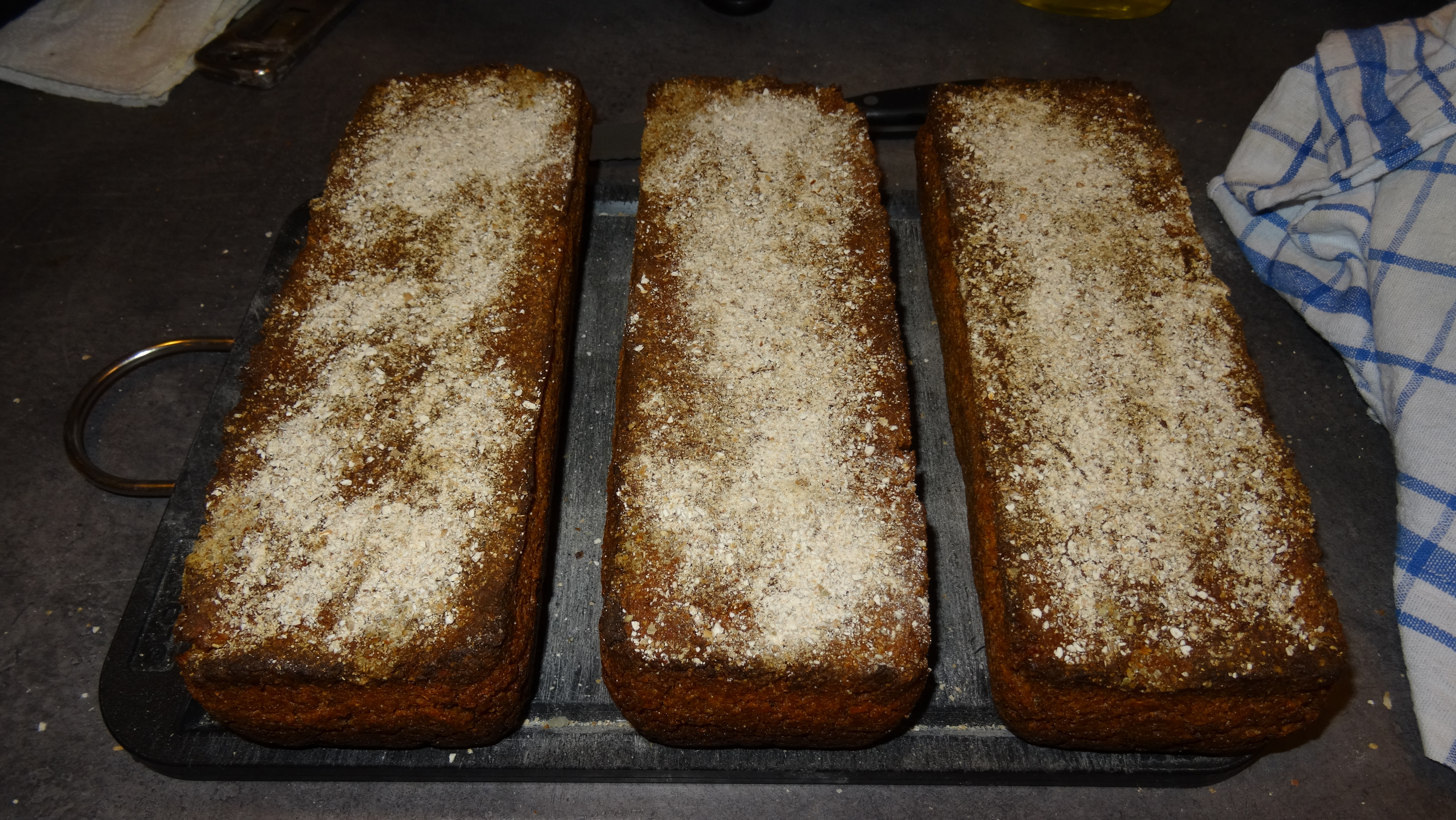
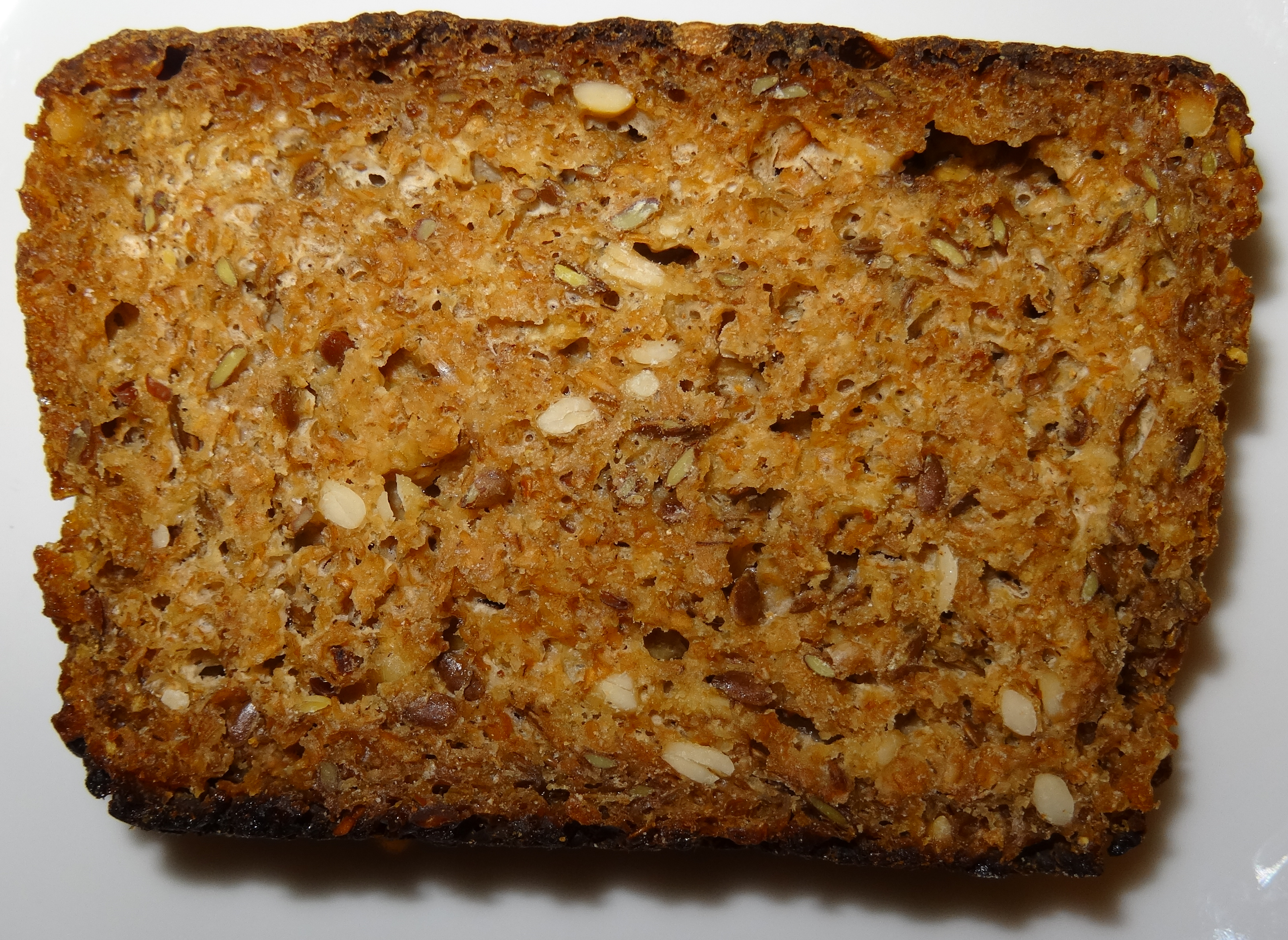
Danish Rye Bread
Levain: 12 hours prior to mixing the final dough
- 153 g water
- 55 g 100 % hydration rye sourdough starter
- 92 g coarse ground rye flour
- 20 g Scandinavian dark syrup
- 214 g boiling hot water
- 110 g coarse ground rye flour
- 70 g sunflower seeds
- 60 g linseed
- 12 g salt (Note: Add the salt after the flour and once the dough has come together. Otherwise, the salt may kill the yeast/sourdough.)
- 120 g Scandinavian dark syrup
- 121 g coarse ground rye flour
- 96 g fine ground wheat flour
- + scalding
- + levain
Levain: Add water warm. Add the starter. Stir to dissolved it somewhat. Add the rye flour and the syrup. Mix the levain until everything is well incorporated.
Scalding: Mix the dry ingredients. Add the boiling water and stir until everything is mixed well.
Final Dough: Put the levain in a bowl large enough for the final dough. Add the syrup, rye flour, wheat flour and mix well. Add the scalding and mix until it's well incorporated. Butter a non-stick loaf pan well using liquid margarine. Put the dough in the non-stick loaf pan. Use a spoon to distribute the dough evenly in the loaf pan. Chop downwards in the entire dough to make sure there are no air-pockets. Wet the back of the spoon and smoothen out the top of the loaf. Put the loaf pan in fermentation bag (or produce bag / large plastic bag) and seal the bag. Leave to rise for 24 hours at app. 77 °F / 25 °C. Put a baking sheet in the oven one rack below the middle one. Put the loaf pan in the oven when it's still cold. (That way the loaf will hold together better.) Bake at 392 °F / 200 °C for 35 minutes. After that: Turn the loaf pan over, flipping out the loaf upside down onto the baking sheet. Having the loaf upside down gives extra crust to the bottom of the bread. Put a cooking thermometer in the loaf. Stick the needle into the center of the loaf. Raise the oven temperature to 437 °F / 225 °C and bake the bread until the temperature of the center of the bread is 208 °F / 98 °C. (If it starts to get burnt: flip it over again) ENJOY!
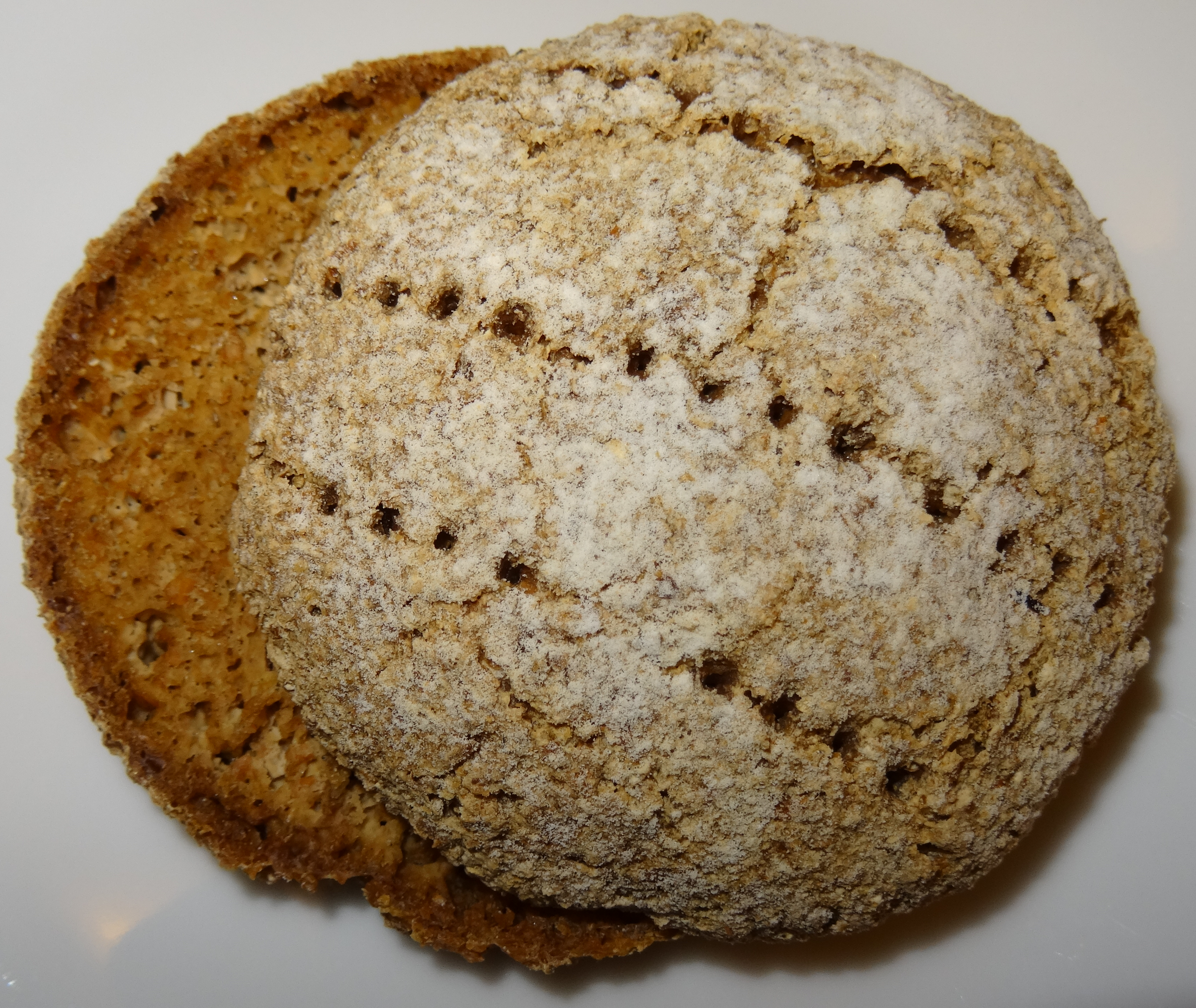
Finnish Rye Bread
Levain: 12 hours prior to mixing the final dough
- 100 g 100 % hydration rye sourdough starter
- 400 g water
- 200 g coarse ground rye flour
- 100 g fine ground wheat flour
- 1000 g water
- 24 g salt (Note: Add the salt after the flour and once the dough has come together. Otherwise, the salt may kill the yeast/sourdough.)
- 84 g chinese soy sauce
- 1200 g coarse ground rye flour
- 400 g fine ground wheat flour
- + levain
Tuesday 07:15 am - 10h45m - Tuesday 06:00 pm - 76h - Friday 10:00 pm - 12h - Saturday 10:00 am - Bake at 446 °F / 230 °C
Instructions
Tuesday 07:15 am - Levain
Tuesday 06:00 pm - Put in a bowl. Keep at room temperature (72 °F / 22 °C).
Friday 10:00 pm - Make biscuits and place on a baking sheet under a baking towel to rise.
Saturday 10:00 am - Bake at 446 °F / 230 °C
Stir the levain in the water so it dissolves somewhat. Add rye flour, wheat flour, soy sauce and finally the salt. Mix it well in a food processor. Let it rise at room temperature (72 °F / 22 °C) for 76 hours in the food processor bowl with the lid on.
Separate the dough into 88 g pieces. Roll the pieces of dough into balls. Put it on a parchment covered baking sheet. (8 per baking sheet.) Flatten each ball so it's only 6/16 of an inch high (1 cm). Prick each biscuit 7 times with a fork like this:
⋯ ⋯
⋯ ⋯ ⋯
⋯ ⋯
Dust with wheat flour and leave to rise for 12 hours under a baking towel.
Bake in the oven for 18 minutes at a heat of 446 °F / 230 °C.
Transfer the biscuits wire rack and leave to cool.
Cut each biscuit in half (like a burger bun).
Put them in the freezer (separate them so the don't stick together in the freezer)
When you want a slice. Take one out of the freezer an run it in the microwave for 25 secs. Just so it gets a little warm. Then they'll taste just like they did when they were freshly baked.

Levain bread with sesame seeds
Levain: 12 hours prior to mixing the final dough
- 10 g wheat sourdough starter
- 11 g fine ground durum wheat flour
- 43 g strong wheat flour
- 43 g water
- 340 g strong wheat flour
- 100 g fine ground durum wheat flour
- 311 g water
- 14 g salt (Note: Add the salt after the flour and once the dough has come together. Otherwise, the salt may kill the yeast/sourdough.)
- + levain
Schedule:
Wednesday at 09:00 p.m. make levain
Thursday at 08:00 a.m. Mix final dough
Fold 4 times some time during Thursday
Thursday at 09:00 p.m. Put the dough in the fridge (or when you're home and you're done folding)
Friday 10:00 p.m: Final shaping and put in banneton
Saturday at 09:00 a.m. Baking
Levain: Add the water. Add the starter. Stir to dissolved it somewhat. Add the strong wheat flour and the fine ground durum wheat flour. Mix the levain until everything is well incorporated. Cover the bowl with plastic and put it in a warm spot (77 °F / 25 °C) in the kitchen for 12 hours.
Final Dough: Add the water to the levain. Stir to dissolved it completely. Add the strong wheat flour, fine ground durum wheat flour and mix somewhat. Add the salt and mix until everything is well incorporated. Cover the bowl with plastic and put it in a warm spot (77 °F / 25 °C) in the kitchen for 12 hours. At the end these 12 hours: Fold it 4 times (30 minutes apart)
Put the bowl covered with plastic in the fridge and leave it there for 24 hours. Shaping: Cover a banneton generously with rice flour. Pour generously peeled sesame seeds onto a dinner plate covering the whole base in seeds. Take the dough straight from the fridge (that way it's less sticky) and pour it onto a lightly dusted countertop. Stretch the dough sideways. Then fold it from left to right and right to left. Then roll it up like in the following video. The more time you take doing this, the stickier it will get. Be fast! To avoid stickiness you can dust some flower onto the sticky parts of the dough using a tea ball with a handle. Now pick up the loaf, seam-side up and roll the it back and forth in the sesame seeds on the plate. Cover everything except for the bottom in seeds (which now should be the top. Remember seam-side up). Also dip the ends in the seeds. Put the whole package, seam-side up, in the riceflower dusted banneton. Dust the top of the loaf with regular wheat flower. Put a bread towel folded once on top of the banneton. Put the banneton in a warm spot (77 °F / 25 °C) in the kitchen for 12 hours.
Baking: Put an Enameled Cast Iron Dutch Oven in your oven and set it to 572 °F / 300 °C. You may have to replace the knob of the lid with a construction of your own in case it cannot withstand those temperatures. 20 minutes after it reaches that temperature: Removed the bread towel covering your loaf. Take a baking parchment which has been cut to fit your dutch oven. Put it on top of the banneton. Put a dinner plate on top of it. Flip the whole package upside down. Remove the banneton slowly. It may have stuck. (usually not, but sometimes it does) Brush off some excess flour along the sides of the loaf. Take out the dutch oven and close the oven lid. Remove the lid from the dutch oven. Watch out it's scorching hot! Lift the bread parchment and the loaf carefully wearing oven mittens. Put it in the dutch oven. Put the lid back on. Place the dutch oven back in the oven. Bake it for 15 minutes at 482 °F / 250 °C. Then reduce the temperature to 437 °F / 225 °C. Bake it for 5 mins. Remove the lid of the dutch oven and bake it for 8 minutes more. Done! Take out your dutch oven and flip out the bread. Let it cool for 1-2 hours on a wire rack. Slice it and put it in your freezer. ENJOY! (Bread lasts 6 hours i room temperature but almost forever in the freezer.) When you want a slice: Heat it in a microwave oven for 25 secs at 900 W (or until it's a little bit warm). ENJOY!

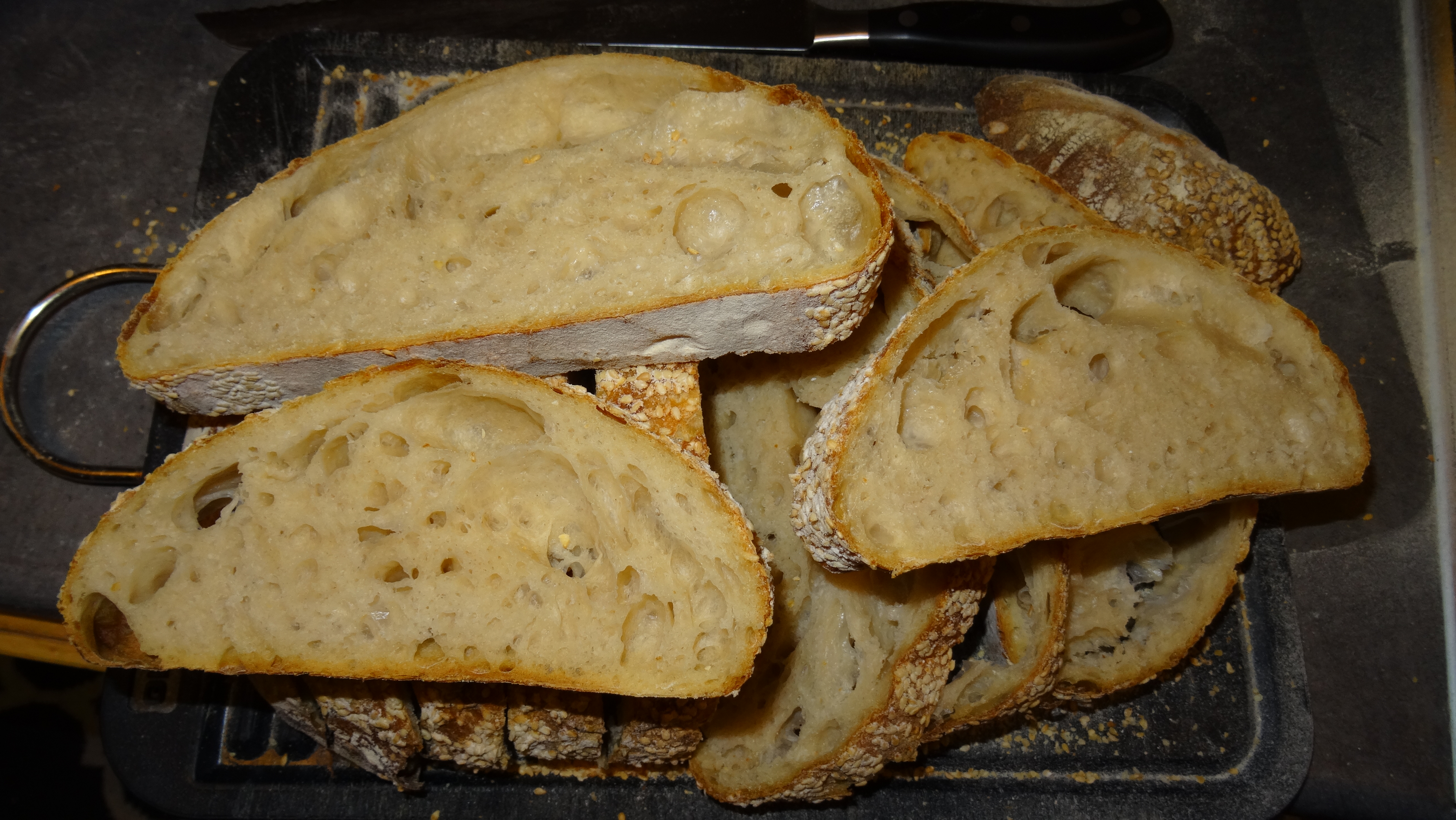
Levain bread with sesame seeds
Levain: 12 hours prior to mixing the final dough
- 15 g wheat sourdough starter
- 16 g fine ground durum wheat flour
- 63 g strong wheat flour
- 63 g water
- 494 g strong wheat flour
- 145 g fine ground durum wheat flour
- 452 g water
- 20 g salt (Note: Add the salt after the flour and once the dough has come together. Otherwise, the salt may kill the yeast/sourdough.)
- + levain
Instructions
Schedule:
Wednesday at 09:00 p.m. make levain
Thursday at 08:00 a.m. Mix final dough
Fold 3 times some time during Thursday
Thursday at 09:00 p.m. Put the dough in the fridge (or when you're home and you're done folding)
Saturday at 09:00 a.m: Final shaping and put in a 14 inch banneton
Saturday at 11:30 a.m. Baking
Levain: Add the water. Add the starter. Stir to dissolved it somewhat. Don't stir with the spoon which you used to take sourdough starter. Clean it first or you'll get too much sourdough starter in the dough. Add the strong wheat flour and the fine ground durum wheat flour. Mix the levain until everything is well incorporated. Cover the bowl with plastic and put it in a warm spot (77 °F / 25 °C) in the kitchen for 11 hours.
Final Dough: Add the water to the levain. Stir to dissolved it completely. Add the strong wheat flour, fine ground durum wheat flour and mix somewhat. Add the salt and mix until everything is well incorporated. Cover the bowl with plastic and put it in a warm spot (77 °F / 25 °C) in the kitchen for 13 hours. At the end these 13 hours: Fold it 3 times (30 minutes apart)
Put the bowl covered with plastic in the fridge and leave it there for 36 hours. Shaping: Cover a 14 inch banneton with rice flour and then all purpose wheat flour. Pour peeled sesame seeds generously onto a dinner plate covering the whole base in seeds. Take the dough straight from the fridge (that way it's less sticky) and pour it onto a countertop. Stretch the dough sideways. Then fold it from left to right and right to left. Then roll it up like in the following video. The more time you take doing this, the stickier it will get. Be fast! To avoid stickiness you can dust some flour onto the sticky parts of the dough using a tea ball with a handle. It's best not to use any flour at all. That way the sesame seeds stick better to the loaf. Now pick up the loaf, seam-side up and roll the it back and forth in the sesame seeds on the plate. Cover everything except for the bottom of the loaf in seeds (which now should be the top. Remember seam-side up). Also dip the ends in the seeds. Put the whole package, seam-side up, in the rice-and-all-purpose-flour dusted banneton. Dust the top of the loaf with all-purpose wheat flour. Put a bread towel folded once on top of the banneton. Put the banneton in a warm spot in the kitchen for 2 hours if your kitchen temperature is 77 °F / 25 °C or 2.5 hours if your kitchen temperature is 69 °F / 21 °C.
Baking: Take some aluminium foil large enough to cover the loaf and shape it like a shallow dome. Put a baking steel or baking stone on a wire rack (or baking sheet) placed in the lower half of your oven. Turn on your oven when there's one hour left of rising. Set the oven temperature to 572 °F / 300 °C or as close as you can get to that. (Don't score the bread, don't spray the bread and don't put any water in the oven. It makes the bread go flat.) Remove the baking towel from the bread. Dust the loaf with all-purpose flour to avoid the bread sticking to your peel. Put your bread peel on top of the basket and loaf. Turn the whole package up side down and remove the banneton. Use a baking brush to brush off any excess flour. Open the oven and put the loaf on top of the baking steel/stone. Put the aluminium foil dome on top of the bread in the oven. Turn the temperature down to 518 °F / 270 °C immediately. Bake it for 28 minutes like that. Now remove the aluminium foil. Lower the temperature to 437 °F / 225 °C and bake it at that temperature for another 16 minutes. You can vent steam out every 5 minutes during the last 16 minutes of baking if you want to. (You may have to adjust the baking process to your oven somewhat.) Now take out the bread and let it cool on a wire rack for an hour or two. Never slice hot bread! When it's just a little warm: Slice it and put it in your freezer. (Bread lasts 6 hours in room temperature but almost forever in the freezer.) When you want a slice: Heat it in a microwave oven for 25 secs at 900 W (or until it's a little bit warm). ENJOY!
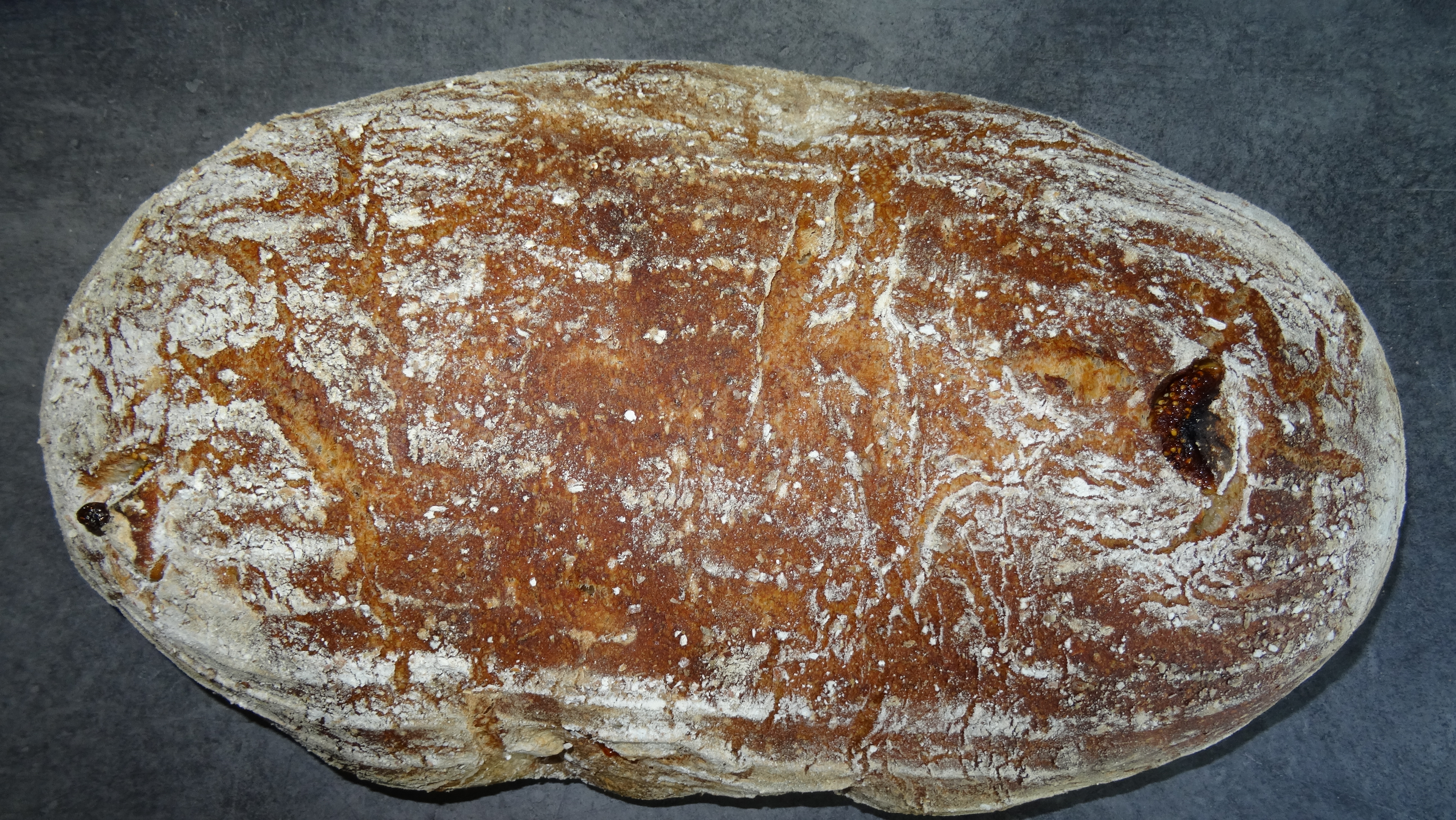
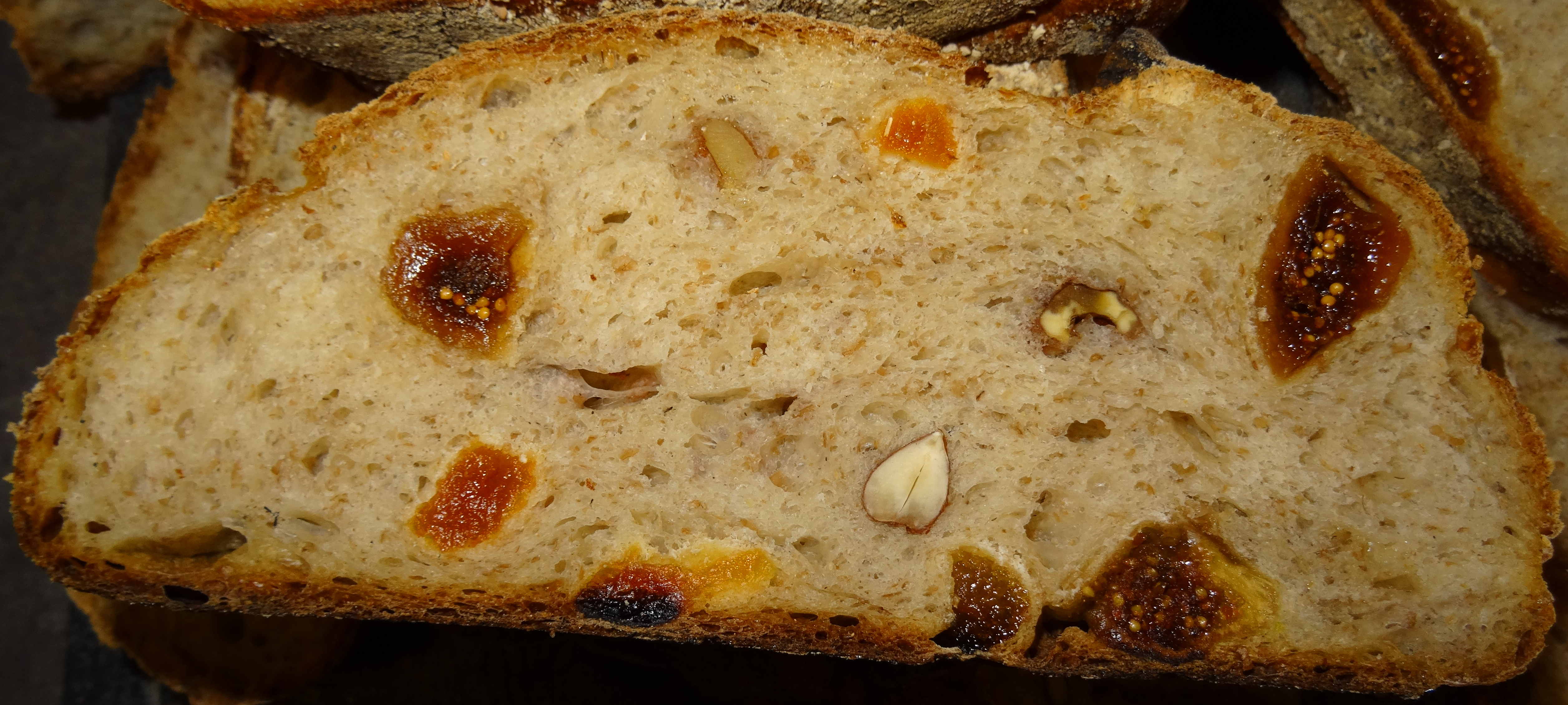
Fruit and nut bread (Hybrid Sourdough)
Actually there are 3 variations of this bread:
Walnut bread
Cranberry and hazelnut bread
Fig, apricot, hazelnut and walnut bread
Levain: 12 hours prior to mixing the final dough
- 49 g rye sourdough starter
- 99 g coarse ground rye flour
- 164 g water
- 277 g water
- 33 g honey
- 20 g salt (Note: Add the salt after the flour and once the dough has come together. Otherwise, the salt may kill the yeast/sourdough.)
- 8 g fresh yeast
- 542 g strong wheat flour
- + levain
- + nuts
- + possibly dried fruits
- 227 g walnut seeds
- or
- 150 g dried cranberries
- 120 g hazelnut seeds
- or
- 39 g hazelnut seeds
- 38 g walnut seeds
- 139 g figs app. 10 pcs, cut off the hard stem and quarter the figs
- 55 g quartered apricots
Instructions
Schedule:
Friday at 09:00 p.m. make levain
Saturday at 09:00 a.m. Mix final dough
Fold 3 times some time during Saturday
Saturday at 11:30 a.m: Final shaping and put in a 14 inch banneton
Saturday at 12:00 a.m. - 2 p.m. Start baking (depending on how fast the bread rises)
Levain: Add the water. Add the starter. Stir to dissolved it somewhat. Don't stir with the spoon which you used to take sourdough starter. Clean it first or you'll get too much sourdough starter in the dough. Add the coarse ground rye flour. Mix the levain until everything is well incorporated. Cover the bowl with plastic and put it in a warm spot (77 °F / 25 °C) in the kitchen for 12 hours.
Final Dough: Add the yeast, water and honey to the bowl of the levain and stir to dissolved it somewhat. Add the strong wheat flour and mix it somewhat. Add the salt and mix it until everything is well incorporated. Cover the bowl with plastic and put it in a warm spot (77 °F / 25 °C) in the kitchen for 30 minutes. Then Fold it 3 times (30 minutes apart)
Cover the bowl with plastic and leave to rise for 1 hour in a warm spot (77 °F / 25 °C) in the kitchen.
Shaping: Cover a 14 inch banneton with rice flour and then coarse ground rye flour. Take the dough straight from the fridge (that way it's less sticky) and pour it onto a countertop. Stretch the dough sideways. Then fold it from left to right and right to left. Then roll it up like in the following video. The more time you take doing this, the stickier it will get. Be fast! To avoid stickiness you can dust some coarse ground rye flour onto the sticky parts. Put the whole package, seam-side up, in the dusted banneton. Dust the top of the loaf with coarse ground rye flour. Put a bread towel folded once on top of the banneton. Put the banneton in a warm spot in the kitchen for ½ - 2 hours.
Baking: When the bread has risen to or slightly above the rim of your banneton it's ready to bake. Take some aluminium foil large enough to cover the loaf and shape it like a shallow dome. Put a baking steel or baking stone on a wire rack (or baking sheet) placed in the lower half of your oven. Turn on your oven when there's half an hour left of rising. Set the oven temperature to 518 °F / 270 °C or as close as you can get to that. (Don't score the bread, don't spray the bread and don't put any water in the oven. It makes the bread go flat.) Remove the baking towel from the bread. Put your bread peel on top of the basket and loaf. Turn the whole package up side down and remove the banneton. Use a brush to brush off any excess flour. Open the oven and put the loaf on top of the baking steel/stone. Put the aluminium foil dome on top of the bread in the oven. Lower the temperature to 482 °F / 250 °C. Bake it for 20 minutes like that. Now remove the aluminium foil. Lower the temperature to 437 °F / 225 °C and bake it at that temperature for another 23 minutes. When the bread looks like it's done: Take it out. (You may have to adjust the baking process to your oven somewhat.) Put your bread on a wire rack and let it cool for an hour or two. Never slice hot bread! When it's just a little warm: Slice it and put it in your freezer. (Bread lasts 6 hours in room temperature but almost forever in the freezer.) When you want a slice: Heat it in a microwave oven for 25 secs at 900 W (or until it's a little bit warm). ENJOY!
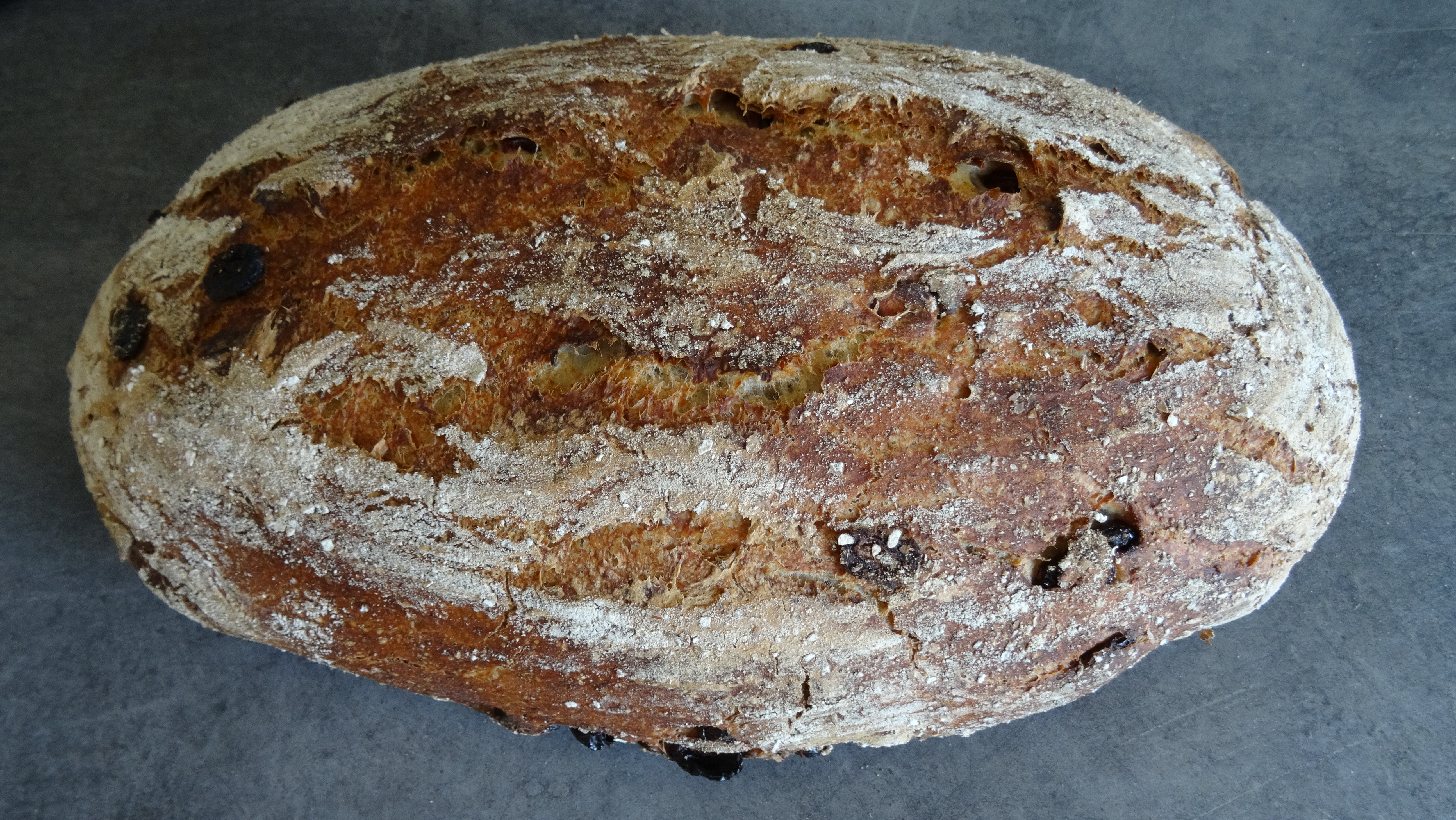
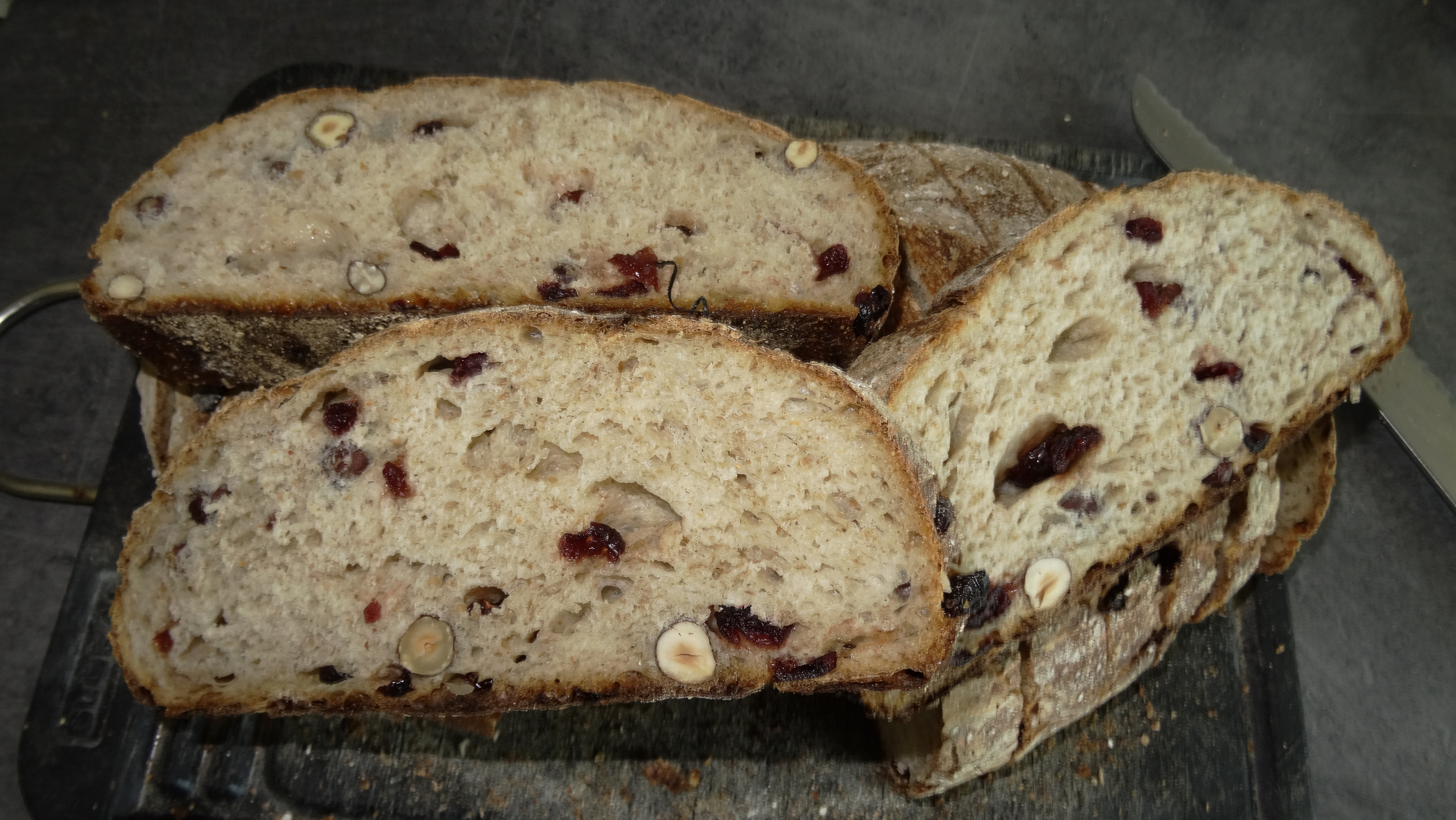
Fruit and nut bread (with sourdough)
Actually there are 3 variations of this bread:
Walnut bread
Cranberry and hazelnut bread
Fig, apricot, hazelnut and walnut bread
Levain: 12 hours prior to mixing the final dough
- 25 g rye sourdough starter
- 15 g wheat sourdough starter
- 118 g coarse ground rye flour
- 48 g strong wheat flour
- 191 g water
- 284 g water
- 515 g strong wheat flour
- 30 g honey
- 20 g salt (Note: Add the salt after the flour and once the dough has come together. Otherwise, the salt may kill the yeast/sourdough.)
- + levain
- + nuts
- + possibly dried fruits
- 227 g walnut seeds
- or
- 150 g dried cranberries
- 120 g hazelnut seeds
- or
- 39 g hazelnut seeds
- 38 g walnut seeds
- 139 g figs app. 10 pcs, cut off the hard stem and quarter the figs
- 55 g quartered apricots
Instructions
Schedule:
Wednesday at 09:00 p.m. make levain
Thursday at 08:00 a.m. Mix final dough
Fold 3 times some time during Thursday
Thursday at 09:00 p.m. Put the dough in the fridge (or when you're home and you're done folding)
Saturday at 09:00 a.m: Final shaping and put in a 14 inch banneton
Saturday at 03:00 p.m. Baking
Levain: Add the water. Add the starter. Stir to dissolved it somewhat. Don't stir with the spoon which you used to take sourdough starter. Clean it first or you'll get too much sourdough starter in the dough. Add the strong wheat flour and the coarse ground rye flour. Mix the levain until everything is well incorporated. Cover the bowl with plastic and put it in a warm spot (77 °F / 25 °C) in the kitchen for 11 hours.
Final Dough: Add the water and honey to the bowl of the levain and stir to dissolved it somewhat. Add the strong wheat flour and mix it somewhat. Add the salt and mix it until everything is well incorporated. Cover the bowl with plastic and put it in a warm spot (77 °F / 25 °C) in the kitchen for 13 hours. At the end these 13 hours: Fold it 3 times (30 minutes apart)
Put the bowl covered with plastic in the fridge and leave it there for 36 hours. Shaping: Cover a 14 inch banneton with rice flour and then all purpose wheat flour. Take the dough straight from the fridge (that way it's less sticky) and pour it onto a countertop. Stretch the dough sideways. Then fold it from left to right and right to left. Then roll it up like in the following video. The more time you take doing this, the stickier it will get. Be fast! To avoid stickiness you can dust some flour onto the sticky parts of the dough using a tea ball with a handle. Put the whole package, seam-side up, in the rice- and-all-purpose-flour dusted banneton. Dust the top of the loaf with all-purpose wheat flour. Put a bread towel folded once on top of the banneton. Put the banneton in a warm spot in the kitchen for 5½ hours if your kitchen temperature is 77 °F / 25 °C or 7 hours if your kitchen temperature is 69 °F / 21 °C.
Baking: Take some aluminium foil large enough to cover the loaf and shape it like a shallow dome. Put a baking steel or baking stone on a wire rack (or baking sheet) placed in the lower half of your oven. Turn on your oven when there's half an hour left of rising. Set the oven temperature to 518 °F / 270 °C or as close as you can get to that. (Don't score the bread, don't spray the bread and don't put any water in the oven. It makes the bread go flat.) Remove the baking towel from the bread. Dust the loaf with all-purpose flour to avoid the bread sticking to your peel. Put your bread peel on top of the basket and loaf. Turn the whole package up side down and remove the banneton. Use a brush to brush off any excess flour. Open the oven and put the loaf on top of the baking steel/stone. Put the aluminium foil dome on top of the bread in the oven. Bake it for 20 minutes like that. Now remove the aluminium foil. Lower the temperature to 437 °F / 225 °C and bake it at that temperature for another 40 minutes. When the bread looks like it's done: Take it out. (You may have to adjust the baking process to your oven somewhat.) Put your bread on a wire rack and let it cool for an hour or two. Never slice hot bread! When it's just a little warm: Slice it and put it in your freezer. (Bread lasts 6 hours in room temperature but almost forever in the freezer.) When you want a slice: Heat it in a microwave oven for 25 secs at 900 W (or until it's a little bit warm). ENJOY!
Cocoa, Coconut and Marshmallow Bars
Ingredients
- One Egg White
- 4.5 dl Caster Sugar
- 1.5 dl Icing Sugar
- 1 tbsp Vanilla Sugar
- 2 tbsp Potato Flour
- 2.5 tbsp Gelatin Powder
- 1.5 dl Boiling Hot Water
- 1.5 dl Cold Water
- 2 tbsp Cocoa Powder
- 150 g Grated Coconut
Pour the egg white in a bowl and mix it for app. 30 seconds using an electric mixer at medium speed.
Add to the bowl:
- 4.5 dl Caster Sugar
- 1.5 dl Icing Sugar
- 1 tbsp Vanilla Sugar
- 2 tbsp Potato Flour